Showing posts with label letting go. Show all posts

Thursday, April 3, 2014

Dharma Series continued!

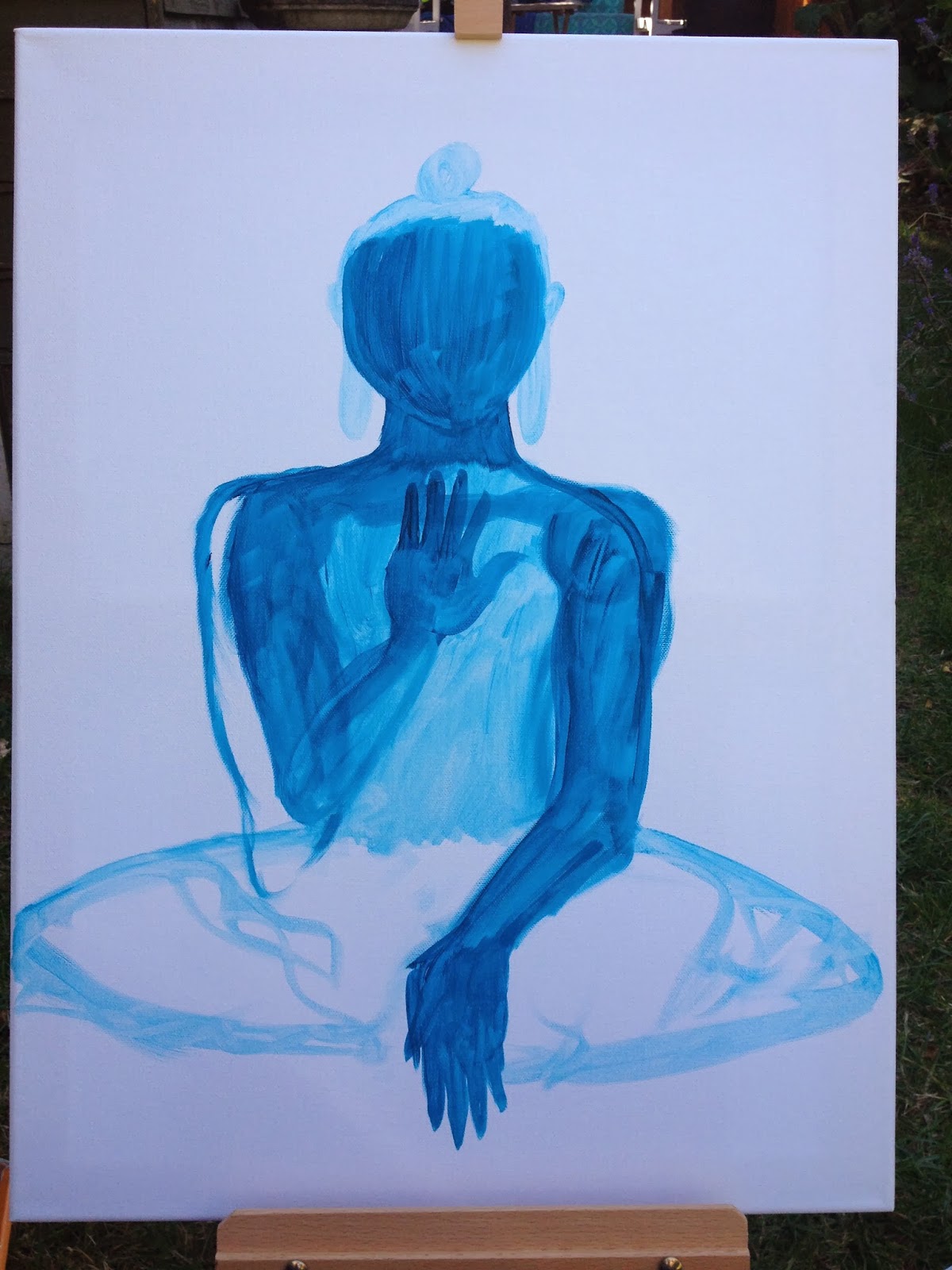
'Non-Attachment'
Pencil Crayon and ink on A4 Bristol Board

The Buddhist concept of non-attachment is often misunderstood in Western culture. For example, I once told a friend I was going to buy a set of mala beads to help me with my meditation practice. Her comment was that buying something wasn't very Buddhist.

I retorted by saying non-attachment wasn't about not owning stuff. I could have a whole house full of stuff but what would be Buddhist of me would be accepting, if that house burned down, the loss of all my possessions.

Since then my understanding of this has deepened quite a bit and I can see my own explanation as quite weak because non-attachment is not rooted in the physical world.

One thing I've learned while on my path is there will be a shift from intellectual understanding of a teaching to a deep 'knowing'. Intellectually I understood that letting go would result in an overall improvement to my sense of wellbeing because obviously, if I put less importance in 'stuff', the loss of said 'stuff' wouldn't bother me so much.

This made perfect sense to me and was reflective of one of the many important lessons my mum taught me when I was growing up. She made it abundantly clear that if my brother or I were to break a glass, for example, it was far more important that we weren't hurt than that we'd been careless. As human beings we had more value than a thing.

Recently I experienced the shift from intellectually grasping this idea of letting go, to a deep 'knowing'. I came to see how attachment has nothing to do with the 'thing', but with our perception of it. To genuinely practice non-attachment we must learn how to view the world without expectation. 

It's not about letting go of things but letting go of perceptions and ideas about how the world should or shouldn't be. Effectively, non-attachment is accepting the world as dynamic, fluid, ever changing. 

My intention was to capture this realisation in this piece of work. Whether I accomplished that or not is unknowable, but I enjoyed making it and ultimately, that's all that matters.

Thursday, January 16, 2014

Hair as Art

When I was fourteen I asked my mum what she would think if I coloured my hair blue.

"Do I have to pay for it?" she asked.

"No," I told her.

"Then knock yourself out."

I don't think she expected I'd become quite so committed to colourful hair, keeping it blue nearly solidly for the next four years. I mixed it up occasionally by shaving my head entirely but as soon as it was long enough again I'd have it bleached and put the colour back in.

When I was eighteen I mixed it up by doing my hair rainbow for Pride celebrations. This soon became an annual style - applied just in time for my birthday on the 1st of May and up kept until mid-July, at which point the incredible maintenance of keeping six colours in my hair would be just way too much.

The rainbow! 
Generally the blue was my 'natural' colour from the unnatural selection, but I saw my hair as yet another material to use when expressing myself creatively. It's been hot pink, green for Christmas, black for Hallowe'en, and red just to use up some excess dye.

One of the last combos I did was blue with a pink strip down one side of my faux hawk, the hairstyle I've sported almost exclusively since 2003. I called this 'My Little Pony' hair and it was this colour I had in my hair last when I began growing out the roots in preparation for moving to London.

Gotta get it nearly white
before putting dye in. 
I've never had a challenge getting a job with my hair coloured. I can guarantee it was not my natural dark brown when I applied for any of the jobs I've had since graduation, but something told me it would be a good idea to have natural hair for my job search in London. I knew it was going to be challenge enough getting work given none of my experience was in the UK and all my references were a seven hour time difference away.

Just before my move I had my hair cut so all the colour was gone. I was also the proud owner of a rat tail, which my best friend snipped off much to the relief of pretty much everyone who knew me.

Within two months I was working at Pancreatic Cancer UK, where I would remain for the next two and a half years. A few weeks into working there I ran the idea of colouring my hair by the CEO and was told she wasn't comfortable with it. I felt a bit odd without colourful hair but I respected her request and carried on.

Four years later and I have a job where there is no concern about the colour of my hair - or clothes or anything else for that matter. Having felt that not colouring my hair hadn't been my choice, I decided to give it a go over the holidays, reviving the My Little Pony look.

Ran out of gloves…
couldn't be bothered to go buy new ones.
I was so excited to have my bright hair back! To play with the canvas on my head and experiment once again! Until it was done…

As I towelled my head dry after washing the dye out with ice cold water and conditioner, I remembered just how much work it is to upkeep the colour.

I miss my brown hair. I miss washing my head with hot water every day. And I no longer identify with brightly coloured hair - as much fun as it is.

It's interesting to look back and see how I've changed and grown. There was a time when, if asked to list what made me me, I would have indisputably included blue or rainbow hair.

What I find most refreshing about this discovery is how comfortable I am with letting go of something I'd always felt defined me. I think it was Leonard Cohen who said, "The less there is of me, the happier I am."

There's something very rewarding about not holding on so tightly to how I think I should or shouldn't be or something I feel defines who I am.

Thursday, November 21, 2013

Unfinished work

This post is an ego challenging post. I'm extremely hard on myself (who isn't?) and for every completed project I can find something that I've abandoned, either because the inspiration ran out or it just no longer was something I wanted to do.

This is fine, of course. Because I know I have finished a lot of projects of which I'm extremely proud. And I completed them wholeheartedly and very successfully. Like publishing my very first book this year or painting all those tarot cards over a period of two years or successfully changing my career in under six months - to name a very few.

But I still have this odd shameful cloud that follows me when I see my unfinished projects. I know that they're not necessarily going to stay unfinished. There is every chance that I will one day sit down to them again. But for now they are incomplete.

Like this painting:


Which got a little further along than this and has now been sat wedged beside my bookcase for well over two months.

Not to mention all that work I used to do when I thought I was going to write and illustrate my own children's book. Or the animation I made a cute character for and began taking shots of but abandoned after just a week because I couldn't muster the energy to do the drawings needed for the second part.

So why, exactly, am I telling you about my unfinished work? Because I'm practicing letting go of being the person who finished everything she sets out to do. Because I'm letting go of the need to be 'perfect' and 'together' and 'disciplined'.

Because I don't want to think of them as shameful secrets but rather simple expressions of ideas I was able to start but not follow-through with... and that's okay.

It's okay not to finish everything you start. It's okay to let an idea sit for a long time. It's okay to put something aside and forget to do it or just outright change your mind about doing it.

So this is sort of like a confessional post. I'm popping my own bubble and admitting to the world:
I don't finish everything I start and I have some brilliant ideas that I've totally abandoned out of laziness or a sense of overwhelm or because I just couldn't be bothered anymore.

I have to say - just writing this - is a massive relief.

Thursday, December 13, 2012

Too Much Air-time

It's important to get stuff off your chest. Bottling things up doesn't help and if anything it will only compound an issue until it ends up blowing up into something much bigger - that old 'Mountains out of Molehills' adage.

But letting off steam is different from constant complaining. Letting off steam is releasing something and then letting it go. A kettle doesn't suck the steam back in when it's done boiling.

Constant complaining involves revisiting the same thing repeatedly. For example, if you find the behaviour of someone you know particularly irksome so you repeatedly air your frustrations with them to anyone who will listen.

They certainly may be doing different things that you find annoying, frustrating and bothersome, but your general complaining is bound to be the same old thing regardless of their behaviour.

Sometimes I can let it go really easily. I am able to reflect on the behaviour of others and I know that I can't change them, I can only change myself.

That might mean letting go of a friend or no longer following someone on Facebook. It might mean learning to just shrug something off because really, it's probably no big deal.

But occasionally I come across someone who really gets under my skin. I find them so frustrating that I'm baffled and I find myself repeating my frustration to anyone who will listen.

Fortunately, I am surrounded by some very wonderful friends and family who are really good at pointing this out to me. Mostly it involves a lot of eye rolling and looking bored because, even if it's a new 'shocking' thing the person has done to annoy me, I'm still being annoyed - again.

I think learning how to be responsible for our own moods regardless of the behaviour or actions of others is probably one of the most difficult lessons in life. It's not easy to accept and remember that we are each responsible for ourselves and how we feel, think and act is entirely our choice.

A lot of it involves changing the way I think about something. I don't like the idea that someone I don't really like or respect is getting so much of my time and energy. When I catch myself mid-whine I pause and just think, "You are giving them way too much air-time."

Thursday, October 25, 2012

The Choices We Have

I am the proud fur-mother to three delightful cats. They provide me with comfort and fill my life with joy and love. I adore each of them for their individual personalities and quirks.

I love them unconditionally. They bring home smaller creatures they have caught, sometimes still alive, at inconvenient times like 3am, when I'd rather be sleeping. They track mud into the house and leave crumbs in my bedding and fluff all over everything I own. They occasionally claw the carpet or the furniture. 

These things do not bother me for two important reasons: 

1. I adore having fur-children, the company they provide and the delight I feel when I spend time with them. 

2. They are cats and it is in a cat's nature to kill small things, run around outside, roll in dirt, shed fur and claw things. They cannot help how they were made and having a cat is a choice I made and one I made because of the reasons listed in reason #1. 

In short, you can't get angry at a kitten for being a kitten. 

I've written on this subject before but I felt like revisiting it for a few reasons. 

I believe that the world is made better through the practice of compassion and that compassion is found through empathy - our ability to understand someone else's experience regardless of our own. 

I also believe that we do the best we can with what we know. Therefore, it's not unreasonable to apply the thought that you 'can't get angry at a kitten for being a kitten' to your neighbour, or that terrible driver who cut you off, or a random stranger on the tube. 

I want to be very clear, however, that I am not excusing ill behaviour. If someone causes us pain, physically or emotionally, their actions are still not deemed "O.K." purely because they didn't know any better. Their lack of skill is not an excuse - but it is a reason. 

I spend a lot of time thinking about this because it's so very easy for us to judge a person by their actions without seeing the many experiences and consequences which led them to behave the way they do. If I'm ever struggling in this department I like to keep this phrase in mind: 

No one does anything because they want to feel worse. 

Human beings don't like suffering. This is a plain fact of life. When we look around us we can see proof of it all over the place. We care a lot about what other people think of us. We care about our health. We want to be comfortable, safe, warm, full, and happy. We strive for it. 

So when someone does something which we might find offensive, appalling, or downright mean, remember: They're not trying to make themselves feel worse. They're just not going about making themselves feeling better in a particularly effective way. 

The choice we have is how we choose to act in the face of 'a kitten just being a kitten'. We might not be able to change how someone else chooses to behave but we always have a choice when it comes to our own behaviour as long as we are paying attention. To pay attention means to recognise when something isn't particularly resourceful or effective. 

If an action, a phrase or a particular behaviour is going to make a situation worse or perpetuate an already difficult situation, we have the choice to change our own response. It's not an easy task but it's definitely worth doing if it means we become better able to handle the general bumps of life. 

What do you think? Can you think of a particular time when you were able to change your own way of thinking or behaving so that a difficult situation could be resolved or diffused? 

Please comment below! 

Monday, October 8, 2012

Relax! It's only life after all.


I love First World Problem memes but not just because they're amusing. They also remind me of something really important: Not to take myself so seriously.

When we take ourselves too seriously it means we're clinging really hard to an idea or thought. I can always tell if I'm taking myself too seriously because I'll get worked up over something pretty small.

If my phone stops working or my computer crashes, it won't affect my health. It might annoy me, if I let it, but when I tag 'first world problem', to the end of a complaint it diffuses the energy it might carry. It's no longer a significant problem because it puts it into perspective. 

I totally recommend this as a great tool to help you relax and let go of things which, really, are of very little consequence.

Your problems are still your problems, but it's a nice reminder that most of the problems we experience are not a threat to our overall wellbeing. I'm not starving, I'm well clothed, I have more than adequate shelter, I have regular income, I have lots of love in my life. With all these needs met, any problem we face should be taken in stride. When we have our basic needs met, we can appreciate that this in itself goes a long way to helping us live happy, fulfilled lives.

Happy Thanksgiving. May you be grateful for all that you have. 


Thursday, September 13, 2012

Learning to say 'No'

In my last entry I wrote about generosity and how we can practice it in little ways day to day. The more we practice generosity the easier it will become, although we may notice at the beginning just how ungenerous we can be.

That's O.K. This is an opportunity for you to practice compassion for yourself. Acknowledge that you are ungenerous sometimes but don't beat yourself up about it. That's like hitting a dog to teach it how to sit. The dog will become confused, scared and possibly will sit but not for the right reasons. The motivation to be generous will come from seeing how it benefits you and the world around you. 

But we must be careful not to give too much. Being generous doesn't just mean giving change to a busker or offering your seat to someone on the bus. Being generous can also mean giving your time or energy to another. We can do this in many ways but it's important not to be taken advantage of. 

I was reading a forum the other day and someone had asked what they could do to help a friend of theirs who was always stuck in a rut. They said they'd spent a lot of time talking to them. They'd offered multiple solutions. They'd even accompanied their friend on several occasions to carry out a plan they'd discussed. But their friend continued to be depressed, downtrodden and generally miserable about things.

There were many responses on the forum but I felt the ones which were the most helpful were the ones which told them to walk away. When we are being generous we are offering help to another, through our kindness, our time, our ability to listen. But we can only help someone as much as they are willing to help themselves and at a certain point we must learn to say, "No." 

It is not selfish or wrong to say "No" to someone or something that drains us. If we feel morally, physically and emotionally drained by a job or a person, we owe it to ourselves to walk away. We do this because we, as much as anyone else, deserve our own love and compassion. We cannot be expected to practice compassion for those around us if we don't practice it for ourselves. We cannot be generous to those around us if we do not understand how to be generous to ourselves. 


Monday, September 10, 2012

Be Generous

There's a misconception that if you have a lot of money or stuff, then you must be greedy. You don't have to be rich to be greedy. I've met some really greedy people who lived paycheque to paycheque, barely able to survive on their income.

The opposite of greed isn't poverty. The opposite of greed is generosity. 

Greed is fuelled by the belief that if we only have more of something - more money, more time, more stuff - then we will be happy. When we act out of greed we act our of a belief that happiness is finite and that, if we don't get our slice, we will miss out.

To be generous is to recognise that happiness is an infinite thing. There is as much love, compassion and kindness in the world as we are willing to make. A generous person doesn't cling because a generous person appreciates the impermanence of all things anyway. Everything will change, everything will rise and grow and fade and die, and thus everything is cyclical. A circle has no beginning and no end.

To practice generosity is to understand that there is enough. To practice generosity is to let go of 'me' and 'mine' and embrace 'us' and 'we'.

We can practice generosity in so many ways. By pausing to hold a door for a mother with a stroller, or helping an elderly gentleman carry his shopping, or offering our seat on the train or bus to someone who looks obviously fatigued, we are acknowledging that our time is no more valuable than anyone elses. We are all equally deserving of compassion and kindness.

There are opportunities to be generous everywhere, every day. All we have to do is look for them.

Wednesday, July 25, 2012

Start with yourself

"Cut me down, but it's you who'll have further to fall" 
-Sia, Titanium lyrics: David Guetta

I believe in the natural goodness of all beings. No one does anything because they want to feel worse. We are all trying our best to get on with life and to feel happy, fulfilled and content. For a few people this seems to mean cutting down other people in order to bring them to their own level, rather than working on building themselves up.

If you are a genuine, enthusiastic, hard working person you're more likely to encounter these drainers. They're the sort who will sabotage another's hard work and dedication, rather than getting on with their own life in a positive and successful way.

They're not to be hated though. Hate cannot achieve a positive outcome. Through hate we become embroiled in our own thoughts and feelings. Hate is a little ball which can grow into a massive knot. It will blind us to those around us and ultimately, we will be no better than the subject of our hate because we have restricted ourselves so much.

Looking at it from the flip side, I have great compassion for those who would rather pull someone down than lift themselves up. You have to have a pretty low opinion of yourself if that's the way you live your life.

Think about it: Someone thinks so little of their own ability to grow, change and achieve that they find it easier to gossip, manipulate and cheat others for their own gain.

Not being true to yourself is hard work. When you deny your own skills and talents, you ignore your dreams and squash your own goals, you're putting an awful lot of time and energy into it. Not that living the life you love doesn't require a lot of time and energy too. The difference is, when you are true to yourself and love what you do and your ability to do it, the work is enjoyable. When the things we work at are enjoyable the effort doesn't feel so draining.

I get a great sense of satisfaction from a job well done. I may be tired, I may have had a certain level of stress, but when the outcome means I reached my goal and got to where I wanted, the exhaustion I feel adds to my sense of accomplishment.

When you work hard to tear someone else down you don't have much to show for it. If anyone does notice your achievement, what they're going to notice is that you are manipulative, two-faced and in-genuine.

The challenging bit is letting go of the grievances we have with people who would rather cut us down than build themselves up. Ultimately it's about self knowledge. If you know that you are worthy of what you've accomplished, if you believe in your skills and talents, then the petty actions of another cannot hold you back. 

Thursday, June 28, 2012

Living the Life you Love II

I'm still on holiday for another two weeks. Today's guest post is from a fellow adventure traveller. She moved from Australia to Germany and keeps a brilliant blog about the experience. 

To Discover Your True Self Get Out Of Your Comfort Zone

Comfort zones are called comfort zones because they are precisely that.  When you are in your comfort zone, you know the lay of the land, you don't have to concerntrate on much and you fit into the well worn grooves of your life.  It is comforting and whilst comfort zones are important places to have to allow us to rest and recharge if your whole life is one big fluffy comfort zone, you are stifling your personal growth.

To find out who you truly are and what you are capable of, you have to throw off the comfy comfort zone and go and explore uncharted lands.  This can be doing something you have always wanted to do, but were afraid to do so, like taking a drama class or joining a choir or taking a cooking class.  Or if you are insane like me, this means moving your entire life to a foreign country where you can't speak the language and don't know a single soul.

When I moved to Germany, almost 2 years ago I had just a suitcase and a job offer and only knew how to say Hello, Thank you and Goodbye in German.  I was thrown way out of my comfort zone and into a strange foreign land and I had only myself to rely on.  If I wanted to buy groceries, find out where to buy train tickets or navigate the tricky land of German health insurance, then I had to do it myself.  Of course I had help from friends, but I had to build those support networks from scratch.  Those early months were some of the toughest in my life, but through them I found out just how capable I was.  I was able to throw out parts of my personality I didn't like and cultivate the parts I did like.  I had no one around telling me who I should be or reminding me of who I was. However, if I stuck to what I was like in my comfort zone, I would probably still be sitting in a small studio apartment not knowing a single soul, instead of having a wide range of friends, both German and expat and having the time of my life.

Of course, not everyone is going to get such a life changing experience that will allow them to basically reinvent themselves.  However, you can stretch yourself and test your limits by getting out of your comfort zone.  By doing something you have previously been afraid to do, you find out just what you are capable of.  By joining a new social group based on a common interest, you get to explore part of yourself you might have kept hidden through fear of ridicule or people expecting you to act a certain way.  Also, you never know who you might meet and what impact they will have on your life.  One of my mottos is that you can never have too many friends and you never know if the next person you meet will be someone who will change your life for the better.

Get out of your comfort zone.  Explore your city like you are a new arrival rather than a long-term resident.  Gather up all your courage and do something new, because you won't find out who you truly are whilst sitting on the couch. 

For more brilliant writing from an exPat Aussie, visit: 

Monday, March 26, 2012

The Only Constant


I love family traditions. My family is extremely close and as I grew up we had many traditions which I came to equate with that close bond. Some of them were very simple, such as where we traditionally sat around the table during mealtimes, while others had a bit more elaboration, like how we would hang our stockings at Christmas time and the ritual of getting a plate of cookies and eggnog with rum in it for Santa. 
There were also many neighbourhood traditions. I grew up in an inner city community that had the feeling of a small town. Many of the families that lived there, and still live there, have done so for many generations. We were all very neighbourly and connected. One such tradition was the annual Christmas party hosted by one of the families on our street. 
The thing about these traditions was that they were safe and predictable. I looked forward to them fondly because of the general comfort in them. I knew how they would play out every year and I expected the result to be memorable in a warm fuzzy way. 
The Death Card represents
letting go and accepting change
As human beings we do this a lot. We take a holiday somewhere and it’s so amazing that we keep booking the exact same holiday every year because we want to re-capture that sense of amazement. Or we always order the same thing off the menu of our favourite restaurant because we know we’ll always enjoy our meal. Or we buy the exact same make and model of car as the last one because we’re familiar with the brand. 
It’s easy to say this is just fine and dandy because we know what we like and we stick to it, but I have come to learn that this insistence that we stay with what we know can be extremely problematic. 
If you always holiday to the same place then you never get the chance to discover somewhere new. If you always eat the same thing then you never know what other fabulous meal you might be missing. If you always buy the same sort of vehicle you could be limiting yourself to a model that doesn’t fit your lifestyle. 
In addition to missing out on new discoveries, you’ll also start to stagnate. Sticking with what you know, what you’ve always known, is extremely limiting. There is very little room for personal growth and life can become boring. 
Besides that, this stagnation generally doesn’t fly. Nothing lasts forever' can be a great comfort to someone going through a difficult time, but it applies to the remarkable, entertaining, joyful and happy times as well. When you rely on that meal being perfect every time there’s going to be an awful lot of disappointment when its not up to snuff. And I do mean ‘when’ not ‘if’ because the harder and longer you hold onto something the more the universe will challenge you to let go. 
Change is constant. When something is uplifting or makes us feel good we tend to cling to it because we are so adverse to feeling bad, but just because something gave us a sense of happiness once doesn’t mean it’s always going to. Nor should it. And we will be far less disappointed in life and we accept that the one thing we can rely on is that everything is changing all the time.

Thursday, March 1, 2012

Labels are for food

An entry about labels is likely going to run very, very long so I'm going to focus on one aspect of labels and labelling. I want to share my thoughts on how we label ourselves. 

I think a lot of attention is given to how other people put us in boxes and the struggle we face to break free, but the boxes we make for ourselves can be just as oppressive. A label isn't just a word, it often become part of our identity. For a really long time I was hung up on the idea of collecting labels. In my teen years I liked to describe myself as a blue haired, activist, artistic, writing freak. I wore my label proudly in a two finger solute to my peers, as if having so many labels meant they a) couldn't possibly find room for more and b) couldn't really define me because I'd gone to such great lengths to define myself. 

It wasn't until I entered High School that I started seeing the huge flaw in the labels I'd given myself. I began to see how fluid the world was, how constant change is and how as good as a label might be one day, it may not fit the next. The problem that arises is once you've given yourself a label (like 'I'm one of life's losers') you've just made it that much harder for yourself when something happens to challenge that label. Because your mind is made up and the label is stuck fast you won't let yourself see the positive aspect of getting your dream job, or losing 50lbs, or finishing an art project. You're inclined to find the downside in everything, because your label dictates it so. 

And seemingly positive labels are just as bad. I know this one is a bit more difficult to comprehend but allow me to present an example. 

I have always labeled myself as a happy, positive person so the idea that I might suffer from depression doesn't really sit well with me. As a result I spent years repressing or avoiding my feelings of depression because everyone knows happy, positive people don't get depressed. But this was outright denial and ultimately my avoidance of the issue caused my emotions to push harder for recognition. Soon I'd developed Panic Disorder and then I was a real mess. 

But my solution wasn't to drop the labels, not yet. My solution was to add the anxiety and the depression to my labels. I was a happy, positive, depressed, anxious person. 

You can see the conflict. 

The better solution, and one I now embrace, was to drop all the labels entirely. It's not easy to do and it's an ongoing project, but it's totally worth it. 

Not that I can't be happy and positive - but I no longer think of myself as defined in that way. I have come to accept that you can't define an individual. Change is too constant for that. We deserve to keep an open mind and open heart to all the ever changing possibilities for our own circumstances. 

It's all part of loving yourself first and best. By dropping the labels you open all those little boxes and open yourself to limitless possibilities. 

Tuesday, January 17, 2012

Purging


Original and prints available

The concept of attachment is a very interesting one. In Western society the definition of attachment seems to get mixed up with the definitions for desire, greed and wants. Attachment is not about longing or the accumulation of possessions.

By purchasing a thing one does not commit to attachment. Attachment is when we identify with our possessions in such a way that we grieve at the mere thought of losing them. One common meditation practice is to do a visualization which involves giving away or losing all your possessions. Imagine everything you own. Every item of clothing, all your shoes, books, DVDs, CDs, electronics - TV, computer, laptop, radio, GPS device, phone, mobile - dishes, decorations, appliances, furniture. As you picture each one imagine giving it away. Doesn't matter who to, just as long as it will no longer in any way be in your life. You could post it to a friend overseas or in another country, give it to a stranger on the street or hand it over to a homeless person.

You don't have to do this with absolutely everything you have but try it with a variety of different things because the level of attachment we have can vary greatly depending on our emotional connection to something. For example, giving away your microwave might give you a sense of apprehension but probably won't upset you as much as giving away something really personal like a journal you wrote or the only photograph you have of a beloved relative no longer with us in body. You may also find that the attachment you feel has something to do with your ego because you feel your identity is determined by the specific clothes you wear or the art you choose to hang on your walls.

The idea behind this visualization - behind any meditation practice - is to create a greater sense of awareness. By paying attention to how we feel about the loss of our possessions we can tune into our emotional responses and be guided by what they are telling us. This means we can take a more practical or objective look at our lives and the things we own.

As a result of doing these practices I have developed an agreement with myself. I don't like to work in rules because our brains tend to treat a rule as unchangeable where an agreement has the flexibility to fit in with the fact that our situations, ideas and opinions are constantly changing.

My agreement is to assess the things I own on a six month basis. I ask myself a few key questions:

1. When did I last use/wear/enjoy this item? Was it in the last six months? Was it longer than that?

2. Why have I not touched it? Is it seasonal? Specific to a project I'm not in the thick of at the moment?

3. Is it something I can feasibly see myself needing/wanting in the next six months? For example, am I likely to find a new painting project to do despite having not painted a lot since completing my Tarot cards?

The reason it's an agreement rather than a rule is because some things will take up my interest again even if they're not central to my life at the moment. Other things need to go.

There might a shirt that's been hanging in my wardrobe for eight months - it's perfectly nice, fits me and I quite like it but the occasion to wear it hasn't come up. When did I wear it last? Why has it been so long? Do I really think I'll wear it again? Would it not be better to send a perfectly good shirt to a charity shop where it can be appreciated by someone and help a good cause?

Why not try it for yourself? Give it a go and see what happens. Maybe you'll do it on a 12 month basis, or an 8 month basis. Find a measurement that works for you.

By purging regularly we can help improve the energy in our lives. Old, unused, unappreciated stuff creates clutter which can effect our ability to sleep, our energy when it comes to caring for the space we live in and our attitude towards change.

A regular purge can clear up space that can be used for a new project, a different look to a room or an opportunity to try something you haven't before. Plus you'll have a rewarding feeling by giving your unwanted items to someone who will appreciate and enjoy them.