Showing posts with label dharma art. Show all posts

Tuesday, April 21, 2015

Dharma art - progress

After completing my last Dharma piece I decided I wanted to continue with the trees. I love trees, I really, really do, and have always struggled to capture their detail and beauty when I've tried drawing them. In fact, I generally dislike the trees I draw. I just feel they're flat and lacking in everything I admire and love about a tree, especially an old gnarled tree with years of regrowth and the odd disease that adds character and depth to the bark and twisting branches. 
I decided to do the last piece while I was sitting in meditation. I've recently started sitting for a half hour each time, at least twice a day. So I was sitting there, following the breath, labelling thoughts as thoughts, that whole thing - and suddenly I just saw this Bodhi tree in my mind and I saw all the lines of the detail. 

Now, you may have noticed that my art doesn't generally entail a lot of intricate detail. I really admire art that does and have often wanted to create something with such fine lines - but I've found it comes across as forced and then I lose the pleasure for what I'm doing. 
Until now. 

I feel like I could draw the lines of trees forever. It's almost addictive. Like, I'm creating the character and richness of the surface of something that's been standing for decades, possibly even hundreds or potentially thousands of years. 

I met a 3,000 year old tree in Japan. It was impressive and humbling. It makes me think of the wonderful teaching by Thich Nhat Hanh about seeing the entire universe in a tree. Without the sun, there is no tree. Without the clouds there is no rain, so there is no tree. Without the earth, the minerals in it, there is no tree. 

It's a beautiful example of interconnectedness, interdependence. Very suitable for my Dharma series. 


Thursday, April 16, 2015

Bodhicitta - Dharma Series

"Your Mind is Not a Problem"
11.7X11.7in ink & gouache on bristol board


Lately the focus of my Dharma study has been Bodhicitta. I first encountered the word through - surprise, surprise - reading and listening to Pema Chodron. It’s one of those very difficult to translate words because there isn’t exactly a direct translation available. 

Instead teachers point at different words which capture the essence of what Bodhicitta is all about. Pema herself describes it in so many different ways. 

Bodhicitta is awareness of our compassionate nature. Or Bodhicitta is the ability we have to be big enough for our world and our experience. Bodhicitta is our awakened mind. Bodhicitta is our Buddha nature - the nature of all beings to see the world free of reference points. Bodhicitta is recognizeng interconnectedness, or as Thich Naht Hanh says, ‘interbeing’. 

Our ability to awaken Bodhicitta is our ability to show up for ourselves and for others. In order to do this we work with our own mind, with gentleness and dedication. The more we can see our mind, the more we can sit with our experience, and the most honestly we show up for ourselves, the more we are able to open up to others. 

Our minds may seem like the enemy, at times, which is why gentleness is so important. I’ve recently realised I experience anxiety at its worst when I’m being impatient with myself. The more harsh I am about what I’m feeling, the more challenging working with my mind becomes and the more intense my emotions. But when I’m kind to myself, when I see my mind as workable rather than something that needs fixing, the whole experience softens. My heart opens up and I genuinely feel big enough for my life. 

I didn’t come up with the text for this piece. The person who did is incredibly wise and I am so appreciative of the ways she reminds me to be gentle. The moment she said these words I knew they were the ones that would accompany this piece. 


Your mind is not a problem to fix. 

Thursday, March 19, 2015

This very moment - Dharma Series

'This Very Moment'
A4 gouache on bristol board
Prints and original available: www.faunawolfcreation.com
In one of her many talks Pema Chodron tells this story about having a lot of anxiety bubbling up for an extended period of time. It was relentless and she kept sitting with it and working with it and finding that it just wouldn't go away, so eventually she went to her teacher and told him about what was going on. 

Her teacher was very receptive and had a lot of questions. He wanted her to really go into great detail about the sensation, where it was, what it felt like, did it have a texture or a taste? She described it for him as intimately as she could and then he clapped and said, "Ah! That's the Dakini bliss!" 

This was the first and only reference to a Dakini I had heard in all my study and practice until a few months ago. In Pema's story she goes on to say that she realised that bliss did have the same intense qualities as the anxious feeling she was describing and she was eager to get back to meditation - but when she did the feeling had gone because her resistance to it had gone. 

I thought Dakini was just a Tibetan word for an an emotion or something. In September last year I learned just what, exactly, a Dakini was. 

In fact, pin-pointing the ‘what’ is a bit of a challenge as the Dakini comes in many forms, but the essence is she is a representation of wisdom in female form. Although even that is an over-simplification from what I’ve learned thus far. 

I am the very fortunate owner of a signed copy of Dakini’s Warm Breath by Judith Simmer-Brown and I’ve been dipping in and out of it for some weeks now. I’ve also found Dakini stories popping up in talks I’m listening to by various teachers. My understanding of the Dakini is that they show up when you’re ready for them. 

This piece itself was one of those ones that was entirely unplanned. I sat down to sketch one evening and found myself drawing a Dakini. I decided to paint her using gouache, something I’ve not worked with in some time, and the words came to me during this process. 


I do feel this is just the first of many I will create as I continue my Dharma series. I also want to delve deeper into the words and why I chose them but at this moment I'm finding a total lack of flow in that regard. I will revisit the topic as the whole practice of life and experience as teacher is something I'm coming to appreciate more and more every day. 

Thursday, February 26, 2015

Basic Goodness and Being Kind

'Kindness'
A4 Portrait pencil crayon & ink on bristol board
Prints and original available through www.faunawolfcreations.com
Everyone is basically good. This doesn't mean everyone can't also be a total asshole sometimes. And that also means you are occasionally a total asshole - whether you realise it or not. 

Which is rather liberating really because it means you don't have to be perfect. But you certainly can be kind and compassionate, and ultimately, that’s what basic goodness is about. 

The idea of ‘basic goodness’ as I understand it from studying the Dharma, is not ‘good’ in the sense of virtuous or correct but good as in: we all want to be happy. The best way I ever heard it put was by Pema Chodron when she said, “No one does anything because they want to feel worse.” 

When we put on a jumper because we feel cold, when we shift position so a limb doesn’t fall asleep, when we put a band-aid over a paper cut so it doesn’t sting - these are all signs of our basic goodness. Our basic compassion and care and kindness. 

It may seem easy to argue against basic goodness. We could say that the news is full of examples of basic badness. People kill each other every day. People shoot, bomb and set-fire to others. 

It might seem totally naive to say people are basically good in light of the atrocities that are committed on a daily basis. 

But saying people are basically good is not the same as saying people are basically sane or people are basically self-aware or people are basically skillful. We are all neurotic in our own ways and the discomfort we feel about our neurosis is what drives a lot of our actions. We go into a default mode to try and make ourselves feel better in a constantly changing, unpredictable world. 

We feel like, if we would just bring the world to a perfectly fixed stand-still with everything totally in balance, then we might feel sane. 

So we act foolishly, carelessly, even unkindly or outright viciously. Some more vicious than others. But these actions are still based on this basic goodness, this basic longing we have to be happy. 

The teachings on basic goodness are not saying that we are virtuous. They are saying we all have a longing to connect to happiness, to feel love and belonging. 

Cynics (And cycnism is healthy - no teaching has any value if it doesn’t agree with your own sense of reason. You don’t have to buy any of it and it’s important to test it against your own experience of the world) might say, “Someone who shoots up a school or who convinces a ten year old to be a suicide bomber is evil.” 

Verse 6.39 in the Bodhicharvatara provides a helpful contemplation in this regard: 
If those who are like wanton children
are by nature prone to injure others, 
what point is there in being angry -
like resenting fire for its heat? 

This asks us to consider - if we believe that some people are basically bad then we’re rather foolish for resenting them. Resenting someone for their supposed inherent nature would be like getting angry at a rock for being hard or fire for being hot. 

What greater proof of basic goodness do you need than our expectation that someone shouldn’t harm us? We only think people should know better because we believe they CAN know better. 

In fact, our very shock at reports of violence, our aversion and disbelief, is further proof of this basic goodness. If we truly believe that people are basically bad then we would never be surprised by the things we read in papers. 

And when we read something horrific and we think to ourselves, “I can’t imagine being angry enough to kill for my belief,” that is a sign of our own basic goodness. 

The things we do that cause harm are not born of some inherent evil within us. We are all confused beings scrambling in the same impermanent world. Not a single living creature doesn’t want to feel safe, secure and content. This is the motivation for our actions. 

When a natural disaster occurs I can’t help noticing that the first thing people do, when they realise they can’t do anything else, is reach out to help one another. 


The bodhisattva lives by this. The bodhisattva sees clearly that ultimately, every situation is unknowable and the greatest thing they can do is be there for others. They accept that the world is not a fixable place. There is no single idea of what a ‘perfect’ world would be and even if there was no war, no famine and we weren’t a threat to one another, we would still have to contend with old age, sickness and death. They realise and accept that the greatest gift we can give is to be present for others, to care for them, and to be kind. 

Tuesday, February 24, 2015

We Are Given What We Need - Dharma Art

'We Are Given What We Need''5.14X5.12 pencil crayon and ink on bristol boardPrints and original available
"Our suffering doesn't make us special."
- Elizabeth Mattis-Namgyel

I spent some time contemplating the phrase 'Everything happens for a reason'. I've written about this before but with this Dharma piece and the wording I chose to accompany the Kapala I drew, I wanted to go deeper. 

I much prefer 'Everything happens' and was once explaining my thoughts around this to a friend. I was giving examples of how the idea of having a 'reason' implies some sense of pre-determination or fate. Because the future really is unwritten and we have no idea what might happen next, it's a phrase that simply doesn't fit with reality. Or, if we are to presume that somehow things are predetermined, it implies reason to atrocities. 

I feel it would be immensely unhelpful to tell someone who was raped or who lost their family in a bombing that 'everything happens for a reason.' Giving reason to such pain feels unreasonable and can also lead people into spirals of guilt or shame - like they brought something on themselves or somehow deserved what happened. 

My friend, who was listening very thoughtfully through all this, then said, "How about, everything happens and the meaning it has is all in how you work with it?" 

I loved this and immediately related it to something my psychologist has often said, which is that life is not out to get us and we are never given more than we can handle. Life is perfect this way. And perfection doesn't mean without flaws. 

We are given a lifetime of experiences and as sentient beings we are also given the wonderful tool of our mind to worth with. Any experience we have is an opportunity, whether we label it positive or negative or neutral. How we work with life is the choice we have. We can choose to shut down, to feel victimized by it and go numb to it, or we can choose to be curious about it, to engage with it - even to embrace it. 

Life is a perfect teacher. 

Tuesday, February 3, 2015

Progress

I've been working on more Dharma art lately, as the Oolong Sketch to Lens exhibition was such a success (Thank you again to everyone who purchased my art - without such support funding the creation of more is a challenge). 

In the past I've taken a teaching, come up with some text based on my understanding of it, and created some art to go with it. But lately I've found myself going the other direction. I'm exploring traditional Buddhist art more and more, as well as really saturating my life with the teachings, and the result is a lot of rich symbolism to explore. 

I'm finding there is much less deliberation in the imagery I'm choosing. I find myself looking at a blank piece of paper, listening to a talk, and then suddenly sketching without having planned to. 
I'm also finding myself taking more time with each piece and expanding the materials I'm using. In the case of a Dakini piece I've been working on I decided to paint it with gouache. I've not used gouache in years and forgot how much fun it is to blend. The colours are vivid and traditional thangka paintings often use gouache, so it seems appropriate. 
I'll be posting the finished pieces to my blog as and when they are completed, but for now you can see the full collection as it stands through my website. Prints are available of all of my Dharma Series. 


Thursday, January 22, 2015

Work with your own mind - Dharma Art

'Everything is Workable'
5X5" ink, pencil crayon and gouache on bristol board
When I was very small, like three or four, my mum gave me my first lesson in the importance of working with my own mind. I wanted to go play outside but it was raining and I couldn't. I began to cry and throw a tantrum (Something I was monumentally good at) and she told me point-blank that I could cry all I wanted but the rain wasn't going to stop.

I have no recollection of this occurance but it's become one of many family stories so I've heard it often enough for the message to be delivered multiple times.

When I first discovered Ani Pema Chodron and realised my Buddhist nature, I quickly discovered this to be an essential teaching in all my studies of the dharma: You cannot change external circumstances. You can change your outlook.

This message is in no way unique to Buddhism or any other school of thought. Cliches like 'You can't change people' are pointing at it. Over and over again, this is presented to us in life.

Generally we feel that life would be so much easier if things went our way. If our partner didn't do that really irritating thing. If customers were less difficult. If our boss listened to us. If other drivers obeyed the rules of the road scrupulously.

Despite the delivery of the lesson to my toddler self, it's only been very, very recently that I've understood and began truly applying it.

I cannot change my external circumstances. None of us can. Life happens how it will whether we like it or not.

The only thing we have any control over, the only thing we can work with, is our own state of mind. And this is infinitely workable. Every situation, regardless of how we perceive it, is workable when we approach it from the level of our own mind.

The inspiration for this piece comes from the Garuda - a mythical creature that represents the ability we have to exist without reference points, without the need for external validation.


Thursday, January 15, 2015

That Which Changes Us - Dharma Art

Pencil crayon & ink on bristol board
5X5"
Original and prints available through www.faunawolfcreations.com

"The bodhisattva practices in the middle of the fire."
-Pema Chodron

In Tibetan Buddhism the dragon represents clear seeing, wisdom and compassion. It strips away our delusions and shows us how to have an open heart to everything life offers. 

For a very long time I felt like I could be a stable, functioning human being if only things could level out for a bit. If I had the 'right' job or the 'right' home or the 'right' relationship then maybe I'd find equilibrium and a sense of ease in the world. 

This line of thinking increased my anxiety exponentially and ultimately led me to have a full mental breakdown. Because the world doesn't work that way. Life isn't fair. But life isn't unfair either. It gives us exactly what we need and I've come to learn the most from the difficult situations in my life. 

When I was twenty-three my relationship ended. I was told I was no longer loved and left just six weeks before what was meant to be the wedding of my dreams. 

The experience was incredibly painful and I was offered many platitudes. Most commonly I was told: "Better before than after!" 

Well, several years later I was married and very committed to what that meant for me. Marriage is a curious institution and not one I entered lightly. I set the aspiration to love unconditionally, to do whatever work was required of me for the relationship and to accept the other person as they were. 

But it takes two and after a while I felt the pain of heartbreak as I was once again left by someone who no longer felt the same way. 

I can tell you from experience, totally honestly, that it was no less painful to be left before a marriage than after a marriage. Both experiences involved a lot of heartache and the need to grieve. 

But I don't ever wish either had never happened because I learned so many valuable things from both.

I learned what it means to forgive, truly. I learned that forgiveness is something that can, and indeed must, be offered without having received an apology. It is not condoning the actions of another - someone may have committed murder and forgiveness is not saying that murder is acceptable. Forgiveness is seeing the complexity of another human being and accepting that they didn't know any better. 

And forgiveness is something we do for ourselves as much as we do it for the other. Because forgiveness allows us to heal and it is much better to forgive than to hold onto resentment, anger or righteous indignation, which simply cripple us emotionally and create a sense of 'us and them', which has never served anyone. 

The other valuable thing I learned was what compassion truly means. Genuine compassion, not idiot compassion born of feeling sorry for another or being overwhelmed with the dark and sad things we see in the world. Compassion as a way of seeing our own humanity and that of another and seeing that being kind is the greatest thing we can do to benefit the planet. This does not mean putting ourselves in the path of harm or letting ourselves remain in abusive or mentally distressing situations. 

Without compassion we cannot have forgiveness because it's compassion that allows us to see our shared human experience. It's compassion that lets us see all of ourselves, our own confusion, arrogance, spitefulness and cruelty and recognise that none of us are any better or worse than anyone else. We're all complicated creatures with our own stories. 

I have the greatest compassion for those who lash out at the world around them because I can see so clearly how they make their own lives that much more difficult. These are not people who need more anger directed towards them - they generate enough of that themselves. It's a heartbreaking experience, when we can feel this genuine sense of love for even the most anonymous stranger. 

I was once fortunate enough to be given the opportunity to ask Pema Chodron a question and my question was about compassion. Her answer to me was that compassion is good for the heart. Ultimately, regardless of the situation, if we work on our own mind and heart with a genuine aspiration to cultivate compassion it will do us far more good than holding onto spite, anger or jealousy. 

At the time I was struggling to let these things go and I wasn't about to take her word for it. I spent the last year since asking that question experimenting. When I open my heart to others, when I am kind and don't expect people to be any different than they are, what is the result? 

I can honestly say from experience that it is far better to have compassion than not and that the more I practice in this way the more it becomes my default setting. The world is a much friendlier place when we don't look at other as enemies but rather as comrades in the same challenging, ever changing situation as our own. 


Thursday, January 8, 2015

Learn to Respond - Dharma Art

Pencil Crayon & ink on bristol board
5X5"
Original or prints available through www.faunawolfcreations.com

The tiger is a symbol of confidence and awareness. It's a calm but powerful symbol, representing an animal that knows its place and purpose and sees very clearly. It is a humble but powerful creature. 

Learning how to respond in life is taking the things we learn, the wisdom we find from our experiences, and actually applying them. I've found, more and more often, that answers cause a lot of trouble because an answer assumes that something can be pinned down or that if there is a 'right' answer then there is also a 'wrong' one. 

Life is not so black and white. Life is rich and complicated and what may work well in one relationship or situation may be entirely unhelpful or even detrimental to another. 

Learning to let go of fixed ideas of how things 'should' be is a huge part of my life now, but it wasn't always. I often tried to come up with answers in an attempt to get ground. If I 'knew' something then I could take comfort in that. 

Of course, as soon as I thought I knew something this view was often challenged. The older I get the more I realise I know very, very little. But this doesn't scare me. Instead I find it liberating. Because if there are no definitive answers then every moment can be taken as it is - freshly, with great curiosity and a sense of wonder. 

Even the most mundane of exchanges become an experiment, something I rather enjoy as I was raised by parents who encouraged an inquisitive mind. In fact, my dad has called me a scientist because of my interest in figuring out how things work, in hypothesizing and checking and re-checking results. 

When we approach our life with curiosity it really changes our experience of the world. Suddenly things aren't happening to us so much as happening for us. 

Difficult co-worker? An opportunity to learn clear communication and how to work with frustration. Annoying family member? A chance for us to learn how to accept someone as they are and not try to make them be how we want them to be. Cancelled train? A moment when we can explore our impatience and sense of entitlement and let that humble us. 

Consider life as a game with no rules other than everything will change and the only piece you can control is your own mind and your own outlook. In this way we can learn to respond to things as they are, rather than trying to make them fit into the ideas we have about them or how we wish or hope or think they should be. 

Thursday, January 1, 2015

Thank you!

I'd like to thank everyone who popped down to Oolong in December to see Lyn's and my pieces. I'm immensely grateful to everyone who purchased an original. It means so much to have my work appreciated by others. 

I create it for myself, to deepen my understanding of the Dharma and help me be a kinder, more generous and compassionate person in the world. To have my artwork appreciated by others is icing on top of the joy I get from sharing my creativity. 

I will be adding more to the Dharma series this year and am excited to keep sharing pieces with you through this blog and my Facebook page and Twitter account. 

A great crowd came out of the evening 
Feeling pretty spiffy to be having another exhibition. My third in five years.  
A very happy customer with her original piece. 

The artist and the photographer, pleased as punch and immensely grateful for all the support. 

If you'd like to order a print of any of the pieces you can do so through my website: 

Thursday, December 11, 2014

Avalokiteshvara

'Avalokiteshvara'
24X36in acrylic on canvas
Exhibiting at the Oolong Teahouse in Calgary December 1 - 31
I've been studying Buddhism for seven years now - ever since I discovered the very eloquent and clear teachings of Pema Chodron. In the last year and a half my practice has become significantly deeper as I've taken my understanding of the various techniques and actually started applying them in my life. 

As my dear spiritual companion described it, "It's like I've been tilling the soil and now things are starting to grow." 

The growing experience is so astounding to me because I'll have heard a teachings dozens of times before it clicks. But when it clicks the experience is transformative. It's the difference between intellectually 'getting it' because it makes sense versus having an actual lived experience of something. A moment when the words I've read or listened to match my personal experience of the world. 

Avalokiteshvara is the bodhisattva of compassion and known by many different names depending on the lineage. But the essence is always the same - to love fully and compassionately. 

I'm a huge advocate of this and can honestly say that my experience has shown again and again that it is much better for everyone involved to show love and kindness than anger or aggression. In fact, I've often felt like I'm just not an aggressive person so all these teachings about working with aggression didn't really apply to me. 

But here's one of those moments when I have listened to a teaching and heard it differently: 

I was listening to a talk by Khandro Rinpoche. She was talking about this sense of compassion and embracing basic goodness and being kind. She began to describe our emotional turmoil as aggression and made a list: "Anger is aggression. Fear is aggression. Sadness is aggression." 

I considered what she was saying and it was like feeling puzzle pieces of so many teachings before sliding into place in my mind. I suddenly realised that when the teachings are talking about working with our aggression they don't mean 'don't be angry' or 'work with your anger' - they mean aggression is a fundamental resistance to our experience. 

In short, resistance to the fundamental ambiguity of being human is aggressive. 

It can manifest as anxiety, fear, sadness, depression - but it's all based on wanting to get away from what is, rather than embracing and working with whatever arises. 

Suddenly I realised I'm incredibly aggressive! My anxiety has always communicated my resistance, my shutting down around an experience. And now I can see it, I can work with it. Having had this realisation the way I'm working with my mind now has shifted significantly. 

Avalokiteshvara reminds us to be gentle with ourselves as well as with others. We can only have compassion for others if we have it for ourselves because it's based on understanding shared human experience. 

My understanding shifted considerably as I realised that I was no less aggressive than anyone else. That the term 'aggression' is not being used in relation to anger or rage but in relation to this resistance we all have to the unpredictability of life. 

How liberating. 

Tuesday, December 9, 2014

The power of an open mind


The first time I published my Manjushri piece I wrote about the power of questioning and how this piece was an exploration of that. 

(I also spelled it with the more traditional Tibetan spelling but apparently you can spell it with out without the 'h' - Fun fact!) 

But I digress. 

The Dharma is something to be constantly explored, applied and revisited. As Chogyam Trungpa said, "Live life as an experiment." 

To me this means adjust your hypothesis, try things again, change the control group, never assume and always, always be willing to change your mind. A flexible mind is one that knows nothing can be pinned down. 

A print of this piece is currently being exhibited at Oolong Tea House in Calgary, along with most of the rest of my Dharma series. The original is hanging on my bedroom wall (But available for purchase, if anyone is interested) and therefore the object of regular contemplation for me. 

I continually visit the final line of text in the piece, along with the strong imagery representing the importance of cutting through the ideas we think we have of the world. 

When we look at things as being just one way it causes a lot of grief. An example I like to use for this is eating in our favourite restaurant. 

Say there's a restaurant that we love, that we've gone to dozens, possibly even a hundred times. We enjoy it immensely but one day we go and we get food poisoning. Suddenly we write the restaurant off. We can't go back because we had a single bad experience. Regardless of the high percentage of great experiences, because we had a single negative one, and because that negative experience was our last experience, we may never return again. 

But the restaurant was never 'perfect' to begin with. It couldn't have been. Because it wasn't everyone's favourite restaurant and because not everyone might like the food they serve. Regardless of food poisoning, some people just might hate the cuisine so much they'd never consider it to be a nice place to eat. 

The value we put on things is a projection of our mind based on experience and understanding of the world. But when we think we 'know' something (or someone) we put a box around it. We stop being able to see it from different angles, different points of view. 

Using a restaurant is a rather safe example and one I feel confident in using to communicate my thoughts on the subject, but this applies to everything. No human being, no ideology, political structure, religion - is ever just one way. 

When we can see this it liberates us because it means we're getting closer to seeing things as they are and letting the fluidity of the world we live in touch us. It means we're able to experience the richness and fullness of life. 

To purchase a print or the original piece visit: 


Thursday, December 4, 2014

Prints! The art formally known as an original.

While my Dharma series is on exhibit at the Oolong Tea House in Calgary I don't want those not in snowy Canadia to miss out. If you'd like to order a print of any of these pieces you can do so through my website:

I promise to do my damndest to get them delivered to you in time for Christmas!

You can click on the images to be taken straight to them on my website:


Thursday, November 20, 2014

The Less There is of Me


As you probably know I've got an exhibition coming up next month, for the entire month, at the Oolong Teahouse in Calgary, Alberta. 

When I first began planning this exhibition way back in August I had intended to include this triptych but when I partnered with a photographer for the exhibition I decided against it. 

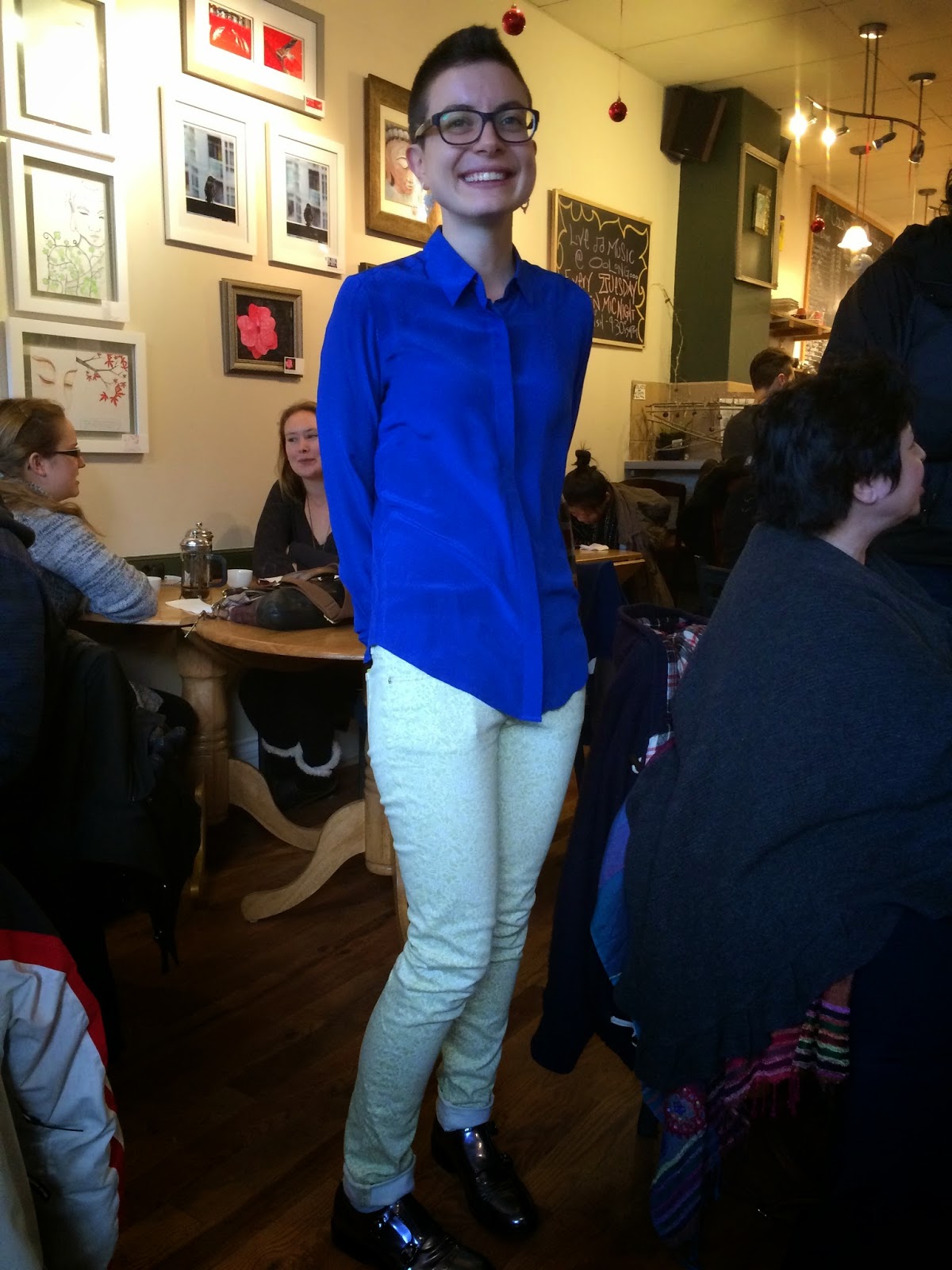
I did this piece very early on this year - in February I believe. It's a series of photos I took as I shaved my head, removing my then blue and pink hair. 

From the age of fourteen until I was 24 I regularly dyed my hair various colours. It was blue for nearly four years straight and then as I entered the working world and could afford to, I did it rainbow for Pride and kept it that way for at least a month. I dabbled in other colours - green for Hallowe'en, pink and blue for the fun of the contrast of it, and blue as the general default. 

My hair was very much part of my identity. I have had various nicknames and many of them had something to do with my hair: Blue meanie, Kool-aid, Rainbow Bright, Peacock... 

When I moved to the UK I knew I was going to be in a distinctly more conservative culture. While looking for work I felt it was important that I gave a good first impression as I know the assumptions people can make when they see brightly coloured hair or tattoos. So I grew my hair out and made sure I was as presentable as possible. I figured, once I'd secured a job and proven myself to be the highly productive employee that I am, I'd then be able to dye my hair again. 

This didn't end up happening though. Partially because the CEO where I first worked in the UK asked me not to and partially because I was sort of enjoying the freedom of having natural hair. Dyed hair requires a lot of work and upkeep and moving to a new country, adjusting to a different culture, starting a new job and also cultivating a new relationship were all very time-consuming things. 

For nearly four years my hair remained uncoloured until late last year when I found myself working somewhere that absolutely embraced and encouraged my creativity. I'd always associated my brightly coloured hair with this creativity and I decided I'd give it another go. I was eager, absolutely and entirely, to have my 'natural' look back. The look I'd identified with so strongly for most of my teenager and young adult years. 

But as soon as I rinsed my hair and saw the colour in the mirror I felt a pang in my chest and a sense of disconnect. I realised that the colour of my hair said nothing about who I was as a person. It was not a statement of my personality or energy. My external presentation may in some ways reflect that but it was not definitive of it. 

And then I had an incredible moment where a lot of the Dharma teachings I'd read and studied about ego and what that means clicked with my experience. 

I suddenly appreciated that a sense of 'me' was actually very artificial and that when I thought in terms of 'this is who I am' in relation to something physical I was limiting myself. I was forming an idea about who I was based on the appearance I chose to put out there. When I didn't have such ideas I felt a great freedom and flexibility. I felt a chance to grow and change and be different every day because every day I am different based on experience. 

It was liberating! Incredibly so! And suddenly something I'd once heard as a quote attributed to Leonard Cohen made a lot of sense to me: 
The less there is of me, the happier I am. 

Because when we think: 'This is Me' we put a lot of importance in it. We give it meaning and if it has meaning we think it really matters. But a lot of time the stuff we apply this meaning to doesn't actually matter at all. But we take ourselves too seriously and then we hold on to things best let go. 

We cling to an idea that people won't know who we are, or that we won't know who we are, if we don't have brightly coloured hair or we don't smoke or we don't dress in a particular way or we don't meditate a certain amount. 

But we were never one way to begin with (This is one of my mantras) and when we realise that it's incredibly liberating. 

It's a paradox as well - people change, people never change. Both are equally true. But what we realise is the things that change can be very superficial and the things that never change are inherent in our nature, our personality. But even these things change because they can deepen or weaken depending on how we choose to live our lives. 

By not clinging to an idea of who we are or who we want people to see us as (no one can truly know another person anyway) we allow ourselves to just be, as we are, in the present moment. 


Thursday, November 6, 2014

Sketch to Lens - December Exhibition in Calgary, Alberta


It's official! From the 1st to the 31st of December, 2014 my Dharma series sketches and Lyn Langille's contemplative photography will be on display at the Oolong Tea House in Calgary, Alberta. 

On the 21st of December you're invited to 'Meet the Artists' from 3:00pm to 8:00pm

My pieces that will be on display can be viewed through the Faunawolf Creations Facebook page. 


Thursday, September 11, 2014

Avalokiteshvara - Dharma Series

'Avalokiteshvara'
24X36in Acrylic on Canvas
Bodhisattvas are beings that forego their own enlightenment in order to help other obtain their's first. They are the embodiment of an idea, not a deity or mythical being, but a personification of a pure intention. 

Avalokiteshvara (pro. Ava-loke-it-esh-var-a) is the bodhisattva of compassion and one of the most commonly talked about and embraced. I've personally been drawn to Manjusri, which is why the first bodhisattva inspired piece I did for the Dharma series was on wisdom, but recently I've been listening to a lot of podcasts that talk about Avalokiteshvara and I wanted to capture the essence of what genuine compassion entails. 

In Buddhist teachings compassion is a thread that runs throughout. It may seem a simple enough concept - be kind, be genuine, be loving - but practicing true compassion is a bit like walking on a tight rope. There are near enemies masquerading as compassion which catch us up. 

Idiot compassion is when we show care and support to others to our own detriment. We put ourselves in harm's way, possibly with the best intentions, and are blind to the damage being caused by the person we're trying to show compassion for. In situations like this the most genuine approach is often to walk away - to prevent them from continuing to cause harm and to show care for oneself by removing oneself from harm's way. 

Overwhelm is when we feel like there is too much 'wrong' in the world and we have to fix it and don't know how. It is this sense of overwhelm that the words I chose for this piece are addressing. 

A closed heart is not stingy but afraid.
Open your heart.
When we let life touch us we see that we are
big enough to hold it all.
When we begin to show compassion we can also feel like we're opening ourselves up to a lot of pain. By relating to the experiences of others through knowing and understanding our own minds the amount of suffering in the world can feel dominant over joy or wonder. 

The teachings of Avalokiteshvara are showing us another way to be open to the pain in and around us by teaching us how to sit with the unfixable nature of the world. The world is not static - everything is changing and therefore illness, old age and death are inevitable. By embracing the inevitability we learn that these things are not 'bad' or 'wrong'. They are the very nature of the universe. 

Energy is neither created nor destroyed. It merely shifts to something different and the passing of time is constant. Rather than resist this, fight and struggle against it and try to 'solve' what is inherently unsolvable, we can learn to be present for it. 

This presence extends to the joyous and beautiful things in life as well. When we feel agitated because we can't take a picture that will do the setting sun justice or our words are inadequate to describe the smell of a flower, this is another sign that we are trying to 'fix' the world in a particular way. We're trying to hold onto something that is in a state of constant change, rather than relaxing into the constant change and accepting that we are as much a part of it as we are able to observe it. 

When we practice this sense of opening up we will experience a shift in the way we view the world. I feel like this is exactly what is being pointed at in the video asking Neil deGrasse Tyson to share the most astounding fact he's found about the Universe. 

We may be very small but we are interdependent on everything around us. We are and can be as big as the universe, which means we can be present and open to all causes and conditions that may arise. I have felt this sensation of my heart being big enough to hold it all. It was fleeting but profound. It was knowing I didn't have to 'fix' anything because nothing was broken. It was not a passive experience but an empowering one because there is great clarity in seeing what we can control and what we can't. 

The experience is ineffable but I believe it's one that many wise and wonderful teachers do their absolute best to point at. 

"When I reflect on that fact, I look up – many people feel small because they’re small and the Universe is big – but I feel big, because my atoms came from those stars. There’s a level of connectivity. That’s really what you want in life, you want to feel connected, you want to feel relevant you want to feel like a participant in the goings on of activities and events around you That’s precisely what we are, just by being alive." 

- Neil deGrasse Tyson


Thursday, August 7, 2014

Dharma Series - Be Unapologetically Magnificent

I recently volunteered myself to paint the fence and deck in the garden of where I live. This resulted in a trip to a local building supplier where an account was officially set-up (Faunawolf Creations now counts as a 'builder' business) and supplies were purchased.

My first step was to paint the bit of stone wall as I figured this would be a quick job I could do on a Sunday morning. I was right, it was a very quick job. My brother is a professional painter/decorator and I think he would be very proud of the end result - which was largely thanks to his advice on the matter.


With the wall painted I began to clean up, but not before thinking it was a lovely blank canvas I'd just created. Evidently, my landlady thought the same thing as a moment later she said, "You know, a mural would look quite good on that." 

I laughed and told her I'd just been thinking the exact same thing and then I realised, she was quite serious. I could have cried with joy, to be perfectly honest, as I've got this thing about doing large scale paintings. 

I asked her what she might be interested in and she gave me a little guidance but was quite happy for me to come up with what I wanted. I considered the space and an idea immediately sprang to mind in line with my Dharma series. I love the shape and elegance of Japanese maple and knew my landlady was partial to the previous piece I did using them. 

The first thing I did was draw and cut out some templates. 


Then I did a quick sketch of the wall and worked out the shape of the branches I wanted to draw. I consulted with the client once more, making sure she was just as pleased as I was with the concept and design. She thought it was brilliant and told me to proceed. 


The branches...

Leaves at the end of the first day of painting

Finished the leaves, now to the text!

'Be Unapologetically Magnificent'
I thought this project would take me a week at least but I've found myself so enthralled with the space and that I've spent both Monday and Tuesday evening working on it, until it was quite suddenly complete! 
The finished piece!!! 

The text for this piece is less my own and more a quote from the recent retreat I attended. Jane Hope was talking about meditation being a way for us to connect with our magnificence - to allow ourselves to BE magnificent. 

This reminded me of a teaching by Thich Nhat Hanh that I'm rather fond of. He talks about being able to see the entire universe in a tree. When you look at a tree you can see the sun because without the sun, there is no tree. And you can see the clouds because without clouds there is no rain and then there is no tree. And you can see the air and the wind because without your breath and mine there is no tree. 

Trees are magnificent. 

The woman I painted this for is magnificent. 

You are magnificent. 


Thursday, July 31, 2014

Just admit you're a fraud. You'll be much happier.

I spent last weekend on a meditation retreat. It was one based in London so it wasn't like I was out in the boonies somewhere, totally disconnected from civilisation. I did refrain from using my phone for most of the weekend and only went on my computer late Sunday after it had ended.

After a retreat I'm exhausted. 

This can be difficult to explain because how does one get so tired just sitting around all weekend?

But meditation isn't just 'sitting around'. Meditation is about being present and for anyone who has ever meditated - even once - you'll be very aware of the fact that we're almost never present.

In fact, the entire theme of this particular weekend, presented by the incredibly delightful Jane Hope, was about recognising the stories we tell ourselves and learning to see what actually is, rather than what we perceive there to be. 

One of my favourite bits of the whole weekend was when Jane was talking about studying these teachings and grasping them at the level of mind (intellectually) but having moments when the teachings suddenly sink deeper and we 'know them on a cellular level'. I found this to be such a wonderful apt description for what happens when our understanding of the world around us deepens because it really does feel like that.

In the case of this particular retreat I found myself revisiting an old wound - seeing a lot of messiness about myself that I always hope I'm leaving behind or that people can't see but that I know is there. Effectively, I spent the weekend just totally embracing that I'm a fraud. 

I never really think I'm 'together' but I know how easy it is to mask something or cover it up and feel like maybe I'm actually more stable than I realised. This was a weekend of seeing my neurosis, how deep it runs and still loving myself regardless. Because I know the people who matter most in my life can see all the messy stuff too and they still love me regardless. They accept me as the complex, messed up human being that I am because the people closest to me know they're just as complex and messed up too. We love each other for it - even if it's not always easy.

So I spent this weekend seeing how much I've not shed and where I'm still messing up and causing pain and being arrogant or foolish. And the neatest thing about it was that it didn't break me because I know that I can't work with anything I'm not willing to see. And I can't accept things as they are if I pretend to be something different. And ultimately, none of this stuff defines me.

But I've rambled on quite enough. I felt this was a good opportunity to share a snippet of a photo piece I did back in February when I shaved my then blue and pink hair off. This is just the first instalment of a triptych which will be on display at my exhibition come December.