Showing posts with label contemplation. Show all posts

Thursday, April 2, 2015

Awe and Wonder - Contemplation

"Don't underestimate the things in your life that will bring you happiness." 
-Pema Chodron

I want to talk about woo. Woo isn’t exactly a ‘real word’ and yet I’ve encountered it in many conversations and even in blogs written by medical professionals, so there does seem to be a growing universality to its use. 

Woo could also be known as ‘airy fairy’ stuff or ‘hippie clap-trap’ or anything along those lines. Practitioners of woo tend to come across as flakey. And woo itself is entirely at odds with science and practicality. 

As a Buddhist I encounter a lot of people who spout woo and I know that a lot of what I study and share is taken as woo. But there is a distinct difference between woo and awe, or woo and wonder, or woo and delight. 

Woo has always come across as fake to me. It’s generally quite harmless but it’s childish in a make-believe way. In the way little children will tell lies so outrageous that adults just laugh. Like ‘I saw a tiny dragon down by the river…actually it was a huge dragon. Oh, and there were two of them!’

In kids it’s cute. In adults it becomes a bit concerning. 

Buddhism is not woo. On the surface it can come across as such and I know it often does. Things like Karma and reincarnation are not properly understood by a lot of people, including Buddhist practitioners. Karma is simplified into some dualistic system or punishment and reward and all about ‘energy’ in a woo way. 

The actual teachings on Karma are in-line with physics - cause and effect. For every action there is an equal and opposite reaction. Inertia. Karma is science. 

And reincarnation is not some mystical idea when the teachings on it are really examined. Again, reincarnation is more science. Energy cannot be created nor destroyed. Our bodies have a lot of energy, our consciousness has a lot of energy. If energy cannot be created nor destroyed then we’ve all already lived forever. 

I’ve never felt that Buddhism and science were at odds with one another and, in fact, the more I study both the more interwoven I find them to be. Because awe, wonder and amazement are crucial elements to scientific discovery. 

Neil Degrass-Tyson is trending right now and has been for several years - and he is full of wonder. I don’t know what, if any, spiritual leanings he has but he definitely sees the universe in a bigger, fuller way than most of us. He says things that match entirely with Buddhist teachings I’ve read. 

Same wisdom, different package. 
“When was the last time you caught a snowflake on your tongue?” he asked a six (and three quarters) year old boy. 

“A few weeks ago.” 

He turned to an adult in the audience and asked the same question. 

“I can’t remember.” 

I caught a snowflake on my tongue the last time it snowed in London. I stood outside and let them land on my face and I enjoyed every freezing touch of it. Because snow is magical. 

I’m about to turn 30 and I’m delighted by seemingly simple things. This comes from appreciation of the world around me, of my interdependence with it, and of the absolute magic to be found in the setting sun or the way a flower blooms or the buzzing of a bee or indeed, the falling of snow. And this is not woo or something flakey. This is appreciation I have for the wonder of life. 

And wonder is not just in the beautiful things we see like a sun-set or sun-rise. Wonder is in seeing the difficult stuff and appreciating it as part of the richness of being human. 


A person who can see the wonder in the most difficult of situations isn’t naive but awake to the fullness of their experience. They can appreciate that something like grief is an expression of love or the energy that accompanies anger. To have wonder is to see the benefit that comes from not rejecting any of our experience. 

And I totally recommend watching this video because what Neil has to say about the meaning of life is totally and utterly spot on. 

Thursday, February 12, 2015

What it means to practice - Contemplation

“If you think you’ve reached enlightenment, go spend a week with your family.” 
Ram Das

'Thoughts as Thoughts'
5X5" prints available
For the last fourteen months I’ve been attending regular meditation retreats at the London Shambala Centre. When I come into work on a Monday after being on retreat my co-workers are often curious and we’ll generally have a conversation about meditation and what I learned on the weekend. 

Once I was met with the statement, “I couldn’t meditate because I couldn’t not think.” 

I laughed and said it wasn’t about not thinking. 

“Then what’s it about?” 

“It’s about being present.” 

It was one of those moments that as I said it I realised it. I was already understanding that this was the whole point of meditation, but I hadn’t quite been able to form words around how it was transforming me. 

So what does it mean to practice? Not just to meditate: coming back to the breath and labeling the thoughts as thoughts and letting them go (Which is not the same as not thinking). That’s a technique. That’s just a way to guide us and point as to the true practice. 


One cannot meditate regularly and not begin to notice the gradual awareness of mind that comes with that. I have, in the last fourteen months, begun to notice the workings of my mind with so much more detail. I don’t just see the thoughts but I see the conditioning behind them, the habitual reactions to them, the hormonal release that accompanies them - adrenalin for an anxious thought, for example. 

'Unfixated Mind'
5X5" prints available
I’ve had this level of awareness for more than fourteen months, to be honest, but have always felt a lot of aggression towards myself when I notice the neurotic and habitual things I do. “You’re frustrated because you’re not enlightened yet,” my psychologist likes to say. 

And I was often frustrated. I was getting better and better at seeing all these ridiculous things I did and yet I kept on doing them. I kept on responding to anxiety with resistance or shutting down around confrontation. I knew these things weren’t helping because I could see it so clearly and yet I couldn’t stop myself. 

Until I began to understand practice very differently. I began to understand that practice is something we do on the spot. Meditation teaches us how to stay on the spot, to relax into or accept the current situation. 

Practice is how we experiment in this place of being present. Practice is seeing what we do clearly because we cannot work with that which we do not see. 

Practice is a willingness to let our family members be themselves - to not expect them to behave any differently - and see what happens. 

'Embrace Circumstances'
5X5" prints available
Practice is feeling anxiety well up because someone disagrees with our opinion and just feeling that anxiety and not trying to make someone like us by retracting what we said. 
Practice is having your train cancelled and noticing how entitled we feel and not pretending any different. 


To practice doesn’t mean these uncomfortable things go away. It means we notice them and work with our mind in a way we never did before. We accept our human-ness and meet ourselves right where we are, with what’s going on in the moment. Because ultimately the only thing we can work with is our mind and the mind exists in the present.  

Thursday, February 5, 2015

The Student & the Teacher - Contemplation

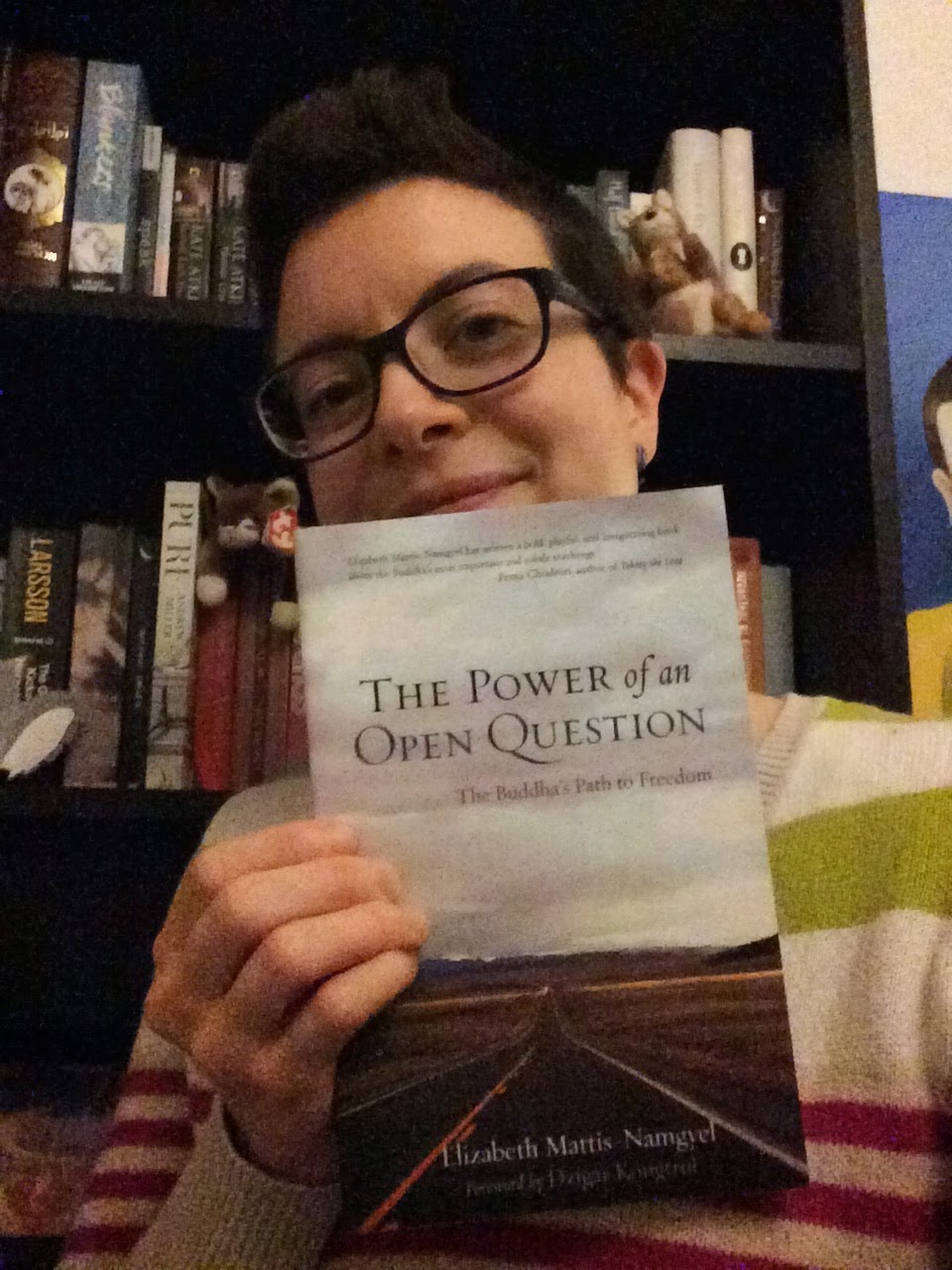
I’ve recently been accepted as a student of Elizabeth Mattis-Namgyel and as a result I’ve been reflecting on what it means to be in a student/teacher relationship within the context of Buddhism. 

Elizabeth's Book
When I wrote Wise at Any Age I included a section on teachers. At the time I wanted to emphasize the idea that teachers come in many forms. A teacher isn’t necessarily someone you even like. In fact, I’ve learned a great deal from incredibly difficult people. The experience I’ve had and how I’ve had to work with myself as a result of living or working with a difficult person has taught me so much. 

But the formal student/teacher relationship within Buddhism is quite different and I’ve been exploring what it means to be a student and to have a connection with a teacher. 

In Buddhist texts this experience is often described as ‘falling in love’. When listening to students of prolific teachers there is a strong sense of this in the way they talk and express their gratitude. But one does not follow a teacher blindly. 

I’ve studied teachings from a great many people, including and not limited to Thich Nhat Hanh, Chogyam Trungpa Rinpoche, Khandro Rinpoche, Shunryu Suzuki, Judith Simmer-Brown, Reggie Ray, the Dalai Lama and of course, Ani Pema Chodron. 

They're all teaching the same things - Buddhist teachings are actually quite brief - but in very different languages. Some are more philosophical, others more academic. Some are more grounded in Eastern culture and traditions, others in the West. Some are far more cutting where others are gentle. 

I have benefited from all of them and continue to do so - but none have had such an impact on my practice as Elizabeth. 

Before I heard Elizabeth teach I had a puzzle of contemplations, thoughts and teachings in my head and I was struggling to put them together. I could ‘get it’ sometimes but it felt fleeting and often I’d revert back to old habits and frustrations. When I first heard Elizabeth teach and it was like the puzzle came together, falling into place easily. 

When we acknowledge the wisdom of others it is recognition of our own wisdom. Elizabeth speaks a language I understand with great clarity. When I listen to her I spend much of my time feeling a deep, profound sense of ‘Yes! That! YES!’. 

I find myself better able to articulate my understanding of the teachings and eager to apply practice to everything. 

As I go back and listen to talks from other teachers I draw lines from their language to hers, deepening my understanding and opening my mind further each time. 


It’s an incredibly powerful and yet also very simple experience. We have had limited contact due to her residence in the States and mine in the UK, and yet I feel connected and supported by her, entirely, because of the mirror she holds up to my practice and the work I’m doing. 

Tuesday, January 27, 2015

Shared Experience - Contemplation

My teacher, Elizabeth Mattis-Namgyel, loves to share the store of Gotami and the mustard seed. The story goes (and I’m paraphrasing here) that Gotami had an infant son who became very ill and died. She carried her son to the Buddha and begged him to bring her child back to life. 

“I can bring your child back,” he said, “But I need something in order to do so.” 

“Anything,” she said. 

“You must bring me a handful of mustard seed from any household in the village where no one has ever died.” 

Gotami said she would and set off on her task. She went to every house throughout the entire village but of course, there was not a single household to be found who had not experienced the loss of someone. 

She recognized that she was not alone in her grief. She realised, as painful as the death of her child was, there was no one else who hadn’t also felt the suffering of loss. 

As Elizabeth explains it, Gotami’s experience shifted from ‘I am suffering’ to ‘There is suffering’. 

This teaching resonates strongly with me and is one I apply often in my life. I grasped this before I’d heard Elizabeth’s teaching on it but didn’t have such an eloquent way of expressing it. She put into words what I understood: that my suffering - intense anxiety, long periods of depression, grief at the loss of anyone - didn’t make me special. 

Doing Tonglen & Metta (loving-kindness) meditation helped me to develop ways of practicing that allowed me to open up into the shared experience of being human. Life is painful sometimes and that the painful things we experience do not separate us from others but actually help us to see and understand how we are all connected. 

Recently I was contemplating this as I was reading Light Comes Through by Dzigar Kongtrul Rinpoche. He is addressing strong emotions, beginning with jealousy. 

Jealousy is not something I’ve struggled with a lot in my life. It’s only rarely reared its head and after studying a bit of Gestalt psychology I’ve learned to look at it as a sign of what I should be doing. For example, I remember being intensely jealous to learn a school-mate of mine in high school had published a book of poetry. My jealousy wasn’t because I wasn’t happy for them and their accomplishment, but because I set the goal to be a published author at a very early age and still wasn’t at that time. 

So I recognised my jealousy not as wishing someone hadn’t done well but wishing that I had done more with my own life. 

I’ve always worked with jealousy this way but as I read Rinpoche’s chapter on jealousy Elizabeth’s words came into my head - but slightly altered. 

It goes from: “They have joy” to “There is joy.” 

Rinpoche asks us to rejoice in the success of others - to experience it as shared because we know how it feels to succeed and we can tap into the feeling when we hear about the good fortune of someone else. 

In all emotions we can apply this shift in our thinking. Emotions don’t define us. They aren’t personality traits. We experience them but they are not solid. So joy is a place we can reside in, just as jealousy is a place we can reside in. 

So the next time you catch yourself thinking in terms of ‘us’ and ‘them’ or ‘me’ and ‘they’ try opening it up. Shift to thinking ‘there is’. There is arrogance. There is happiness. There is anger. There is delight. There is fear. There is wonder. 


When we see more clearly how the human experience is shared our world becomes so much bigger. 

Tuesday, November 9, 2010

Coping Mechanism


Happiness is not measured by possessions, experiences, friends or money. Happiness is loving the life you're leading as you lead it, regardless of the circumstances.

When it comes to art, there really aren't any rules.

Wisdom is the result of lessons learned, not years lived.

Envy is the result of the belief that there is only so much happiness to go around. Happiness is not something you can measure in a cup. It is as boundless as ideas, as endless as the Universe and as ceaseless as the passing of time.

May you be happy, may you be satisfied with your life and may you never stop learning.
A lovely autumn rainbow